In biology class, we’re taught that there are four blood types — A, B, AB, and O — primarily important for blood transfusions. But for several decades now, a more daring idea has been circulating: what if our blood type also dictated what we should eat? This question has sparked an entire movement, fueled by best-sellers and championed by celebrities, that is worth taking a closer look at — both to understand its origins and to see what the research actually has to say about it.
Where do blood types come from?
The ABO system was discovered in 1901 by the Austrian physician Karl Landsteiner, who observed that mixing blood from two different individuals could occasionally trigger dangerous agglutination. This breakthrough, which earned him a Nobel Prize, rendered blood transfusions safe for the first time in medical history.
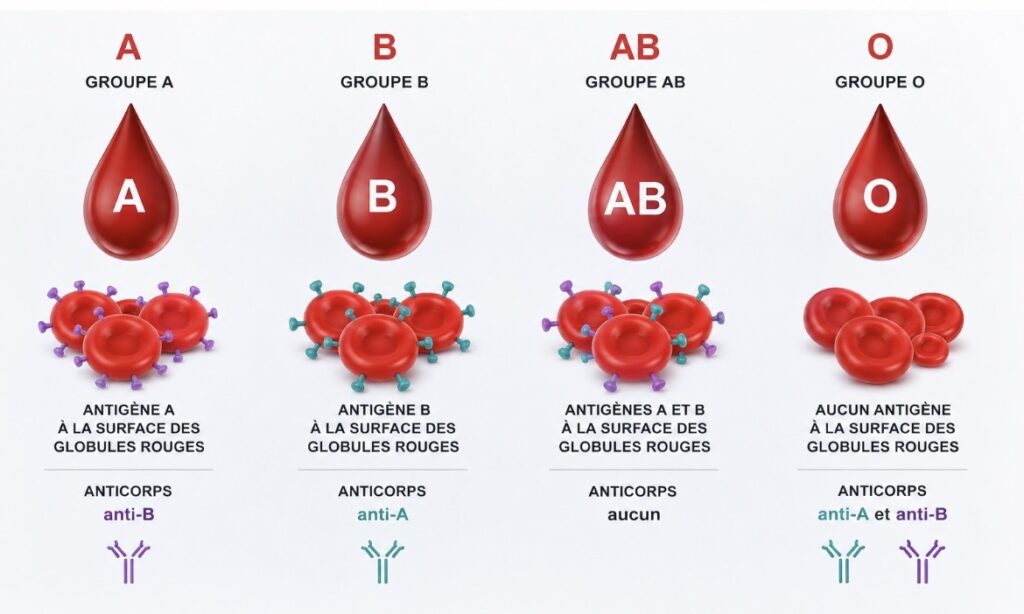
"Each group — A, B, AB, or O — is defined by the presence or absence of specific antigens on the surface of red blood cells. It is this distinction that dictates which blood types are compatible with one another. Globally, type O is the most prevalent, accounting for approximately 40% of the population, whereas type AB remains the rarest.
Beyond this well-established immune function, researchers began to wonder as early as the mid-20th century whether blood type might also influence our digestion, our susceptibility to certain diseases, or even our personality. It is this territory that D’Adamo’s theory would go on to explore several decades later.
The D’Adamo Theory: A Diet for Every Blood Type
"The concept of linking diet to blood type was first introduced by naturopath James D’Adamo in the late 1950s. It was his son, Peter D’Adamo—also a naturopath—who later brought the theory to global prominence with his book 4 Blood Types, 4 Dietspublished in 1996.
The theory is based on the premise that certain foods contain proteins known as lectins, which allegedly react differently within the body depending on one's blood type, potentially causing inflammation or weight gain. From this, D’Adamo derives specific dietary recommendations:
- Type O: Prioritize meat, fish, and vegetables; limit dairy products and grains.
- Type A: A more vegetarian profile, focusing on vegetables, fruits, and grains.
- Type B: The most flexible, allowing for meat, dairy, and vegetables.
- Type AB: A blend of profiles A and B, emphasizing fresh foods and avoiding red meats.
What scientific research says
This is where transparency is required: despite its popular success, this theory has never been validated by independent scientific research.
A 2014 study from the University of Toronto, involving more than 1,400 young adults, concluded that blood type does not alter the effects of diet on health in any way. A systematic review published in 2013 in theAmerican Journal of Clinical Nutrition reached the same conclusion: out of the 16 studies examined, none supported the idea that eating according to one's blood type improves health. The benefits felt by some adherents likely stem simply from the fact that they are adopting a healthier diet (fewer ultra-processed foods), regardless of their blood type.
A cultural success that goes beyond diet.
What makes this subject fascinating is that it has far exceeded the scope of nutrition. In Japan, for example, blood type (called ketsueki-gata) Ketsueki-gata: Japanese "Blood AstrologyKetsueki-gata is a Japanese cultural belief that links one's blood type to their personality, temperament, and compatibility, functioning much like zodiac signs or horoscopes do in the West. It occupies a significant place in Japanese society, influencing romantic relationships and hiring decisions, with an entire mythology associated with the personality traits of each blood group.
Beyond the theories: the voice of my own blood.
Beyond diet, it is in the realm of personality that the impact is sometimes the most profound. We have all experienced that feeling of vertigo when reading a horoscope or a psychological profile: 'But, that’s exactly me!' For me, it didn't stop at mere curiosity. By observing those close to me who share my blood type, I have noticed character traits, reactions, and ways of approaching existence that are disturbingly similar.
Of course, we are not exact copies. But there is this 'resonance': a common way of reacting to conflict, a similar need for independence, or a particular sensitivity. Whether regarding character or digestion—like this friend for whom dairy products as a whole are an insurmountable obstacle, whereas for me, only the very high quality of cheese sometimes makes the difference—I am not seeking here to establish an absolute rule. There are some of D’Adamo’s recommendations that do not work for me at all. But through observing these similarities among those around me, I find myself thinking that there might be a grain of truth, a little inner melody specific to each group, that science has not yet been able to translate into equations.
For a long time, I avoided red meat out of preference. But my body didn't see it that way. My hair became dull, fatigue settled in like an unwanted companion, and this weakness followed me every afternoon. As a Type O woman, I tried the experiment: reintroducing red meat three to four times a week. The change was vital. My strength returned, my hair regained its vigor, and that daily 'fog' dissipated.
If science has not yet validated the exact mechanisms of lectins, the benefit of this approach has been, for me, a liberating turning point. It forced me to stop eating according to external dictates to start listening to the real needs of my own blood. Deep down, I believe there are truths that only intimate experience can reveal. Sometimes, a theory can be the bridge that allows us to reconnect with ourselves.
So, should one follow their blood type to eat?
At present, there is no scientific proof that this method improves health. But that does not mean your personal experience has no value. If you feel that you are doing better by following an approach, it is precious and deserves to be listened to.
While waiting for future research to perhaps nuance this picture, a varied, balanced, and minimally processed diet remains the most solid foundation, regardless of your blood type.
On SOS Médecine Naturelle, we will explore in future articles the specificities of each blood type and the foods that are traditionally associated with them
April 24, 2026
Sarah Martinez
Related articles