
1. Habitat and Growth Conditions
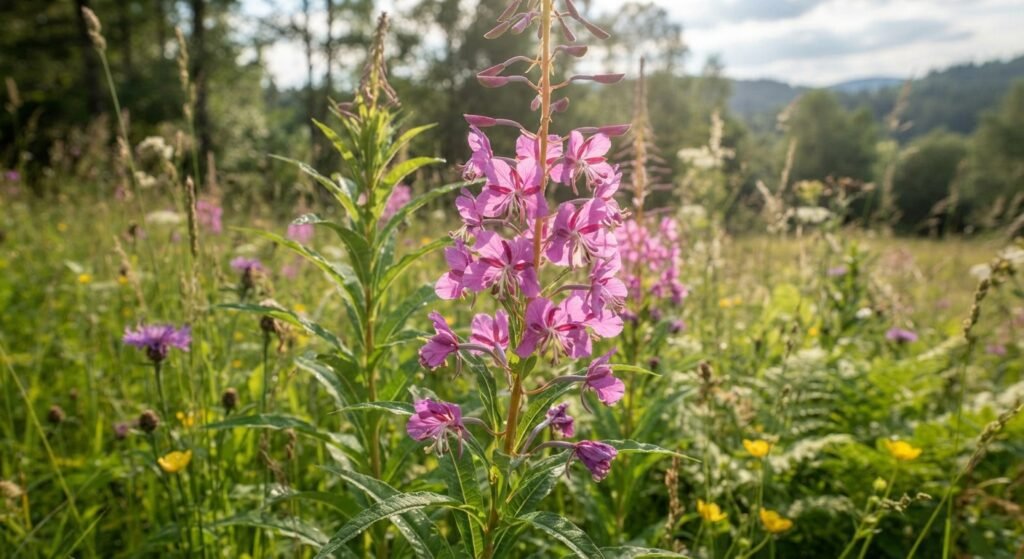
Small-flowered willowherb (Epilobium parviflorum) is a perennial herbaceous plant native to the temperate zones of Europe and Asia. It grows spontaneously in a very specific biotope: moist soils, stream banks, shaded ditches, and the edges of cool forests. It is this direct proximity to pure water and mineral-rich soils that shapes its vitality and all of its vital juices.
2. Detailed Biochemical Composition and Active Principles
Small-flowered willowherb is distinguished by its highly complex molecular architecture. Its richness relies on several major classes of constituents:
- Macrocyclic ellagitannins: The flagship compound identified by research is oenothein B, which serves as the key active ingredient for its targeted action.
- Protective flavonoids: The plant contains derivatives of quercetol, kaempferol, and myricetol, acting as powerful antioxidant shields.
- Phenolic acids and minerals: It also contains organic acids and trace elements that support overall tissue metabolism.
3. The Lesser-Known Virtues of Willowherb: From Urinary Comfort to Overall Well-Being
Long before being targeted for the male sphere, willowherb was traditionally used in herbalism to relieve multiple everyday ailments. Thanks to its richness in tannins and antioxidants, it helps soothe general urinary system discomforts (such as mild cystitis, bladder irritations, or overly frequent urges to urinate in both women and men). Its mild anti-inflammatory properties also make it a precious ally for calming minor digestive inflammation and gently purifying the body, thus expanding its scope of action far beyond men's health alone.
4. Biological Power: How Willowherb Acts on the Prostate
If willowherb has become an essential reference in natural terrain medicine, it is due to its formidable and specific action on the prostate gland, particularly regarding benign prostatic hyperplasia and the accompaniment of tumor issues.
Its mode of action relies on precise mechanisms:
- Targeted enzymatic inhibition: Oenothein B blocks the activity of key enzymes (5-alpha-reductase and aromatase) that stimulate excessive prostate cell proliferation.
- Decongestion and anti-inflammatory action: By modulating inflammatory pathways (such as the NF-kappaB pathway), it relaxes pelvic tissues and restores a smooth urinary flow without disrupting the rest of the body.
- Cellular protection: By neutralizing free radicals at the core of urogenital tissues, it protects cellular integrity and slows the worsening of lesions.
5. Practical Methods of Use
To benefit from the plant's full power while respecting its botanical totum, here is the rigorous traditional method:
- The active infusion: Pour simmering water over one tablespoon of dried aerial parts of small-flowered willowherb. Let steep covered for 10 to 15 minutes, then strain carefully.
- Standard dosage: Generally consume one to two cups per day (one in the morning on an empty stomach, and one in the evening before bedtime) as a cure over several weeks, respecting pause windows.
6. Precautions and Preliminary Trials
Before undertaking any terrain therapeutic approach, it is essential to exercise discernment. In the case of a severe pathology (such as confirmed prostate cancer), the use of willowherb must be part of a comprehensive follow-up supervised by a qualified specialist. During a first use, it is recommended to conduct a preliminary trial with half a cup per day to verify the body's perfect digestive tolerance.
7. Scientific and Botanical References
- Historical works and transmissions of European terrain herbalism (Maria Treben) on the use of the aerial parts of Epilobium parviflorum.Epilobium parviflorum.
- Pharmacological and biochemical studies on the isolation and action of ellagitannins, particularly oenothein B, on prostatic enzymatic inhibition.
- Recent publications in clinical phytotherapy concerning the modulation of urogenital inflammatory processes by plant polyphenolic extracts.
October 5, 2026
Sarah Martinez
Related articles