1. Vivre avec la douleur : l’importance vitale de relâcher les tensions
Faced with the harshness of a severe and painful illness like prostate cancer, daily life becomes an ongoing trial. Pelvic tension, bladder compression, burning sensations, and chronic inflammation exhaust not only the body but also the mind. In this quest for respite, heavy treatments do not always leave room for immediate tissue comfort. This is where terrain hygiene and alternative care find their true meaning: not to pretend to wipe away the disease with the wave of a magic wand, but to offer what conventional medicine often forgets—concrete physical relief, a revival of fluids, and a deep soothing of the small pelvis.
2. Derivative Baths: What Are They and How Do They Work ?
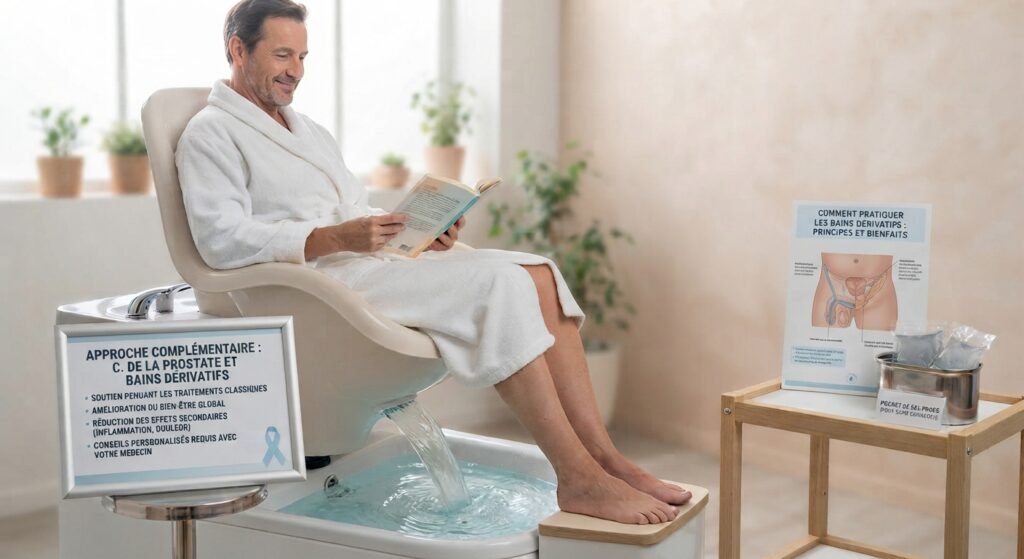
Derivative baths consist of a gentle hydrotherapy practice that uses coolness to stimulate the body from within. The principle relies on a simple physiological law: the perineum area and the groin folds concentrate an extremely dense network of blood vessels, nerve endings, and fascia that envelop the entire urogenital zone.
When local and well-measured coolness is applied to this area, it triggers a gentle thermal stimulation of the smooth muscles and fascia. This controlled thermal shock generates a dual life-saving effect for the prostate:
- The Revival of Flows and Blood Pumping: It creates a reflex contraction of superficial tissues that instantly reactivates fluid circulation, promotes the drainage of toxins accumulated around the pelvic area, and helps decongest the prostate gland.
- Mechanical Release: By relaxing the fascia of the small pelvis, the derivative bath reduces the physical pressure exerted on the urethra and bladder, which alleviates sensations of heaviness and facilitates urinary elimination.
3. Deep Benefits for a Suffering Organism
For a man whose body is heavily taxed by illness, integrating this practice offers precious and measurable benefits:
- Relief from Pelvic Pain: By soothing local inflammation and decongesting engorged tissues, it dispels the sensation of a vise and burning in the lower abdomen.
- Drainage of Toxic Overloads: It supports the body's natural emunctories, helping to cleanse the internal milieu saturated by inflammatory by-products.
- Soothing of the Nervous System: When performed in tranquility, the practice sends a signal of global relaxation to the vegetative nervous system, promoting a release of psychological tension and better sleep.
4. Practical Guide: How to Perform Derivative Baths at Home
The method must be gentle, progressive, and perfectly adapted to a fatigued body. There are two main ways to proceed:
- Method 1: The Refrigerated Gel Pack (The Simplest and Most Accessible)
- Equipment: A flexible gel pack (specially designed for thermotherapy, often called a "cold pack") kept in the refrigerator (never in the freezer to avoid freezing cold that would assault tissues).
- Preparation: Imperatively wrap the gel pack in a thin cotton cloth or towel so that there is no direct, abrupt contact with the skin.
- Application: Settle comfortably in a seated position (in an armchair or on a bed) and place the wrapped pack inside your underwear so that it refreshes the perineum area and the groin folds.
- Duration: Start with 15 to 20 minutes per day, then gradually increase up to 30 or 45 minutes depending on the comfort felt. Ensure the rest of your body is kept warm (wear socks, a sweater, and cover your legs with a throw).
- Method 2: The Cool Water Wash (The Traditional Friction Method)
- Equipment: A bidet or a clean basin filled with cool water (tap water temperature, not iced), and a washcloth reserved for this purpose.
- Application: Seated comfortably, dip the washcloth into the cool water and make gentle back-and-forth movements, without pressing, along the groin folds (on each side of the pubis) moving upward.
- Duration: Perform these cool, gentle passes for 10 to 15 minutes while maintaining a calm and relaxed breathing rhythm.
5. Essential Precautions and Listening to the Body
Faced with a severe pathology, the golden rule is respect for vital energy:
- Never Force in Case of Extreme Weakness: If the person is in a state of extreme fatigue or profound exhaustion, cold should not be used, as the body needs all its energy to defend itself. The body must always feel globally warmed during the session.
- A Complementary Approach: This care in no way replaces oncological treatments or rigorous medical monitoring. It is an invaluable support and comfort tool to get through the ordeal with greater dignity and physical relief.
6. References and Traditions of Vital Hygiene
- Historical works and transmissions in terrain hydrotherapy (notably popularized by Kuhne and France Guillain) on the impact of perineal thermal regulation in decongesting deep organs.
- Clinical observations in modern naturopathy on the management of pelvic pain and the improvement of local microcirculation through gentle thermal stimulations.
October 5, 2026
Sarah Martinez
Related articles