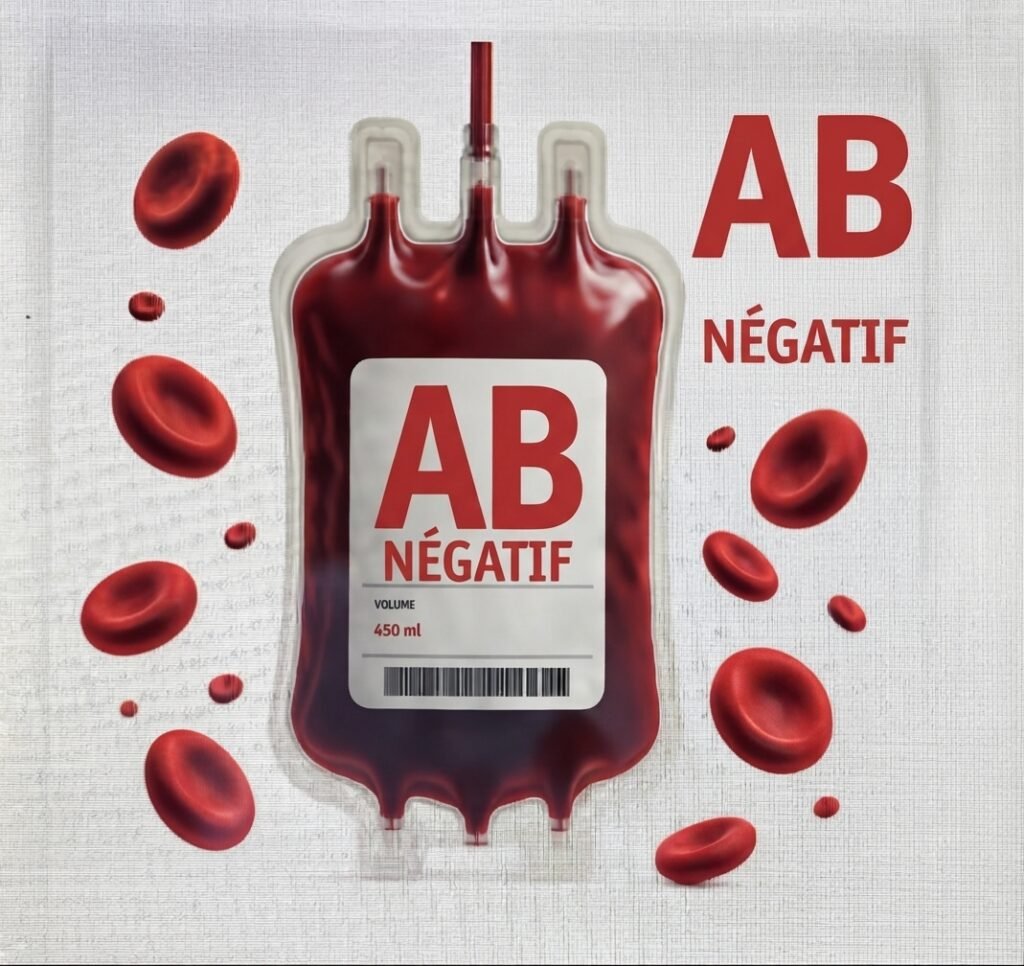

Blood type AB negative (AB-) represents the pinnacle of rarity in the ABO system, affecting less than 1% of the global population (often between 0.4% and 0.6%). A true hematological anomaly, it combines the rarity of the negative Rhesus factor with the complexity of a profile carrying both A and B antigens simultaneously. This article explores this exceptional profile at the crossroads of biology, culture, and cutting-edge science.
The Biological Profile and the Transfusional Challenge
On a hematological level, AB negative red blood cells carry both A and B antigens on their surface, but lack the Rhesus factor (RhD). This unique configuration shapes very specific transfusion rules:
- The recipient versatility: A person with blood group AB- can receive red blood cells from all negative groups (O-, A-, B-, AB-), offering them flexibility for their own needs.
- The universal plasma donor: Conversely, their plasma contains neither anti-A nor anti-B antibodies, making their plasma precious and universally administrable to patients of any ABO group in critical emergency situations.
The Psychology of Blood: The Perspective of Ketsueki-gata
In Japanese and Asian popular culture, the theory of ketsueki-gata reserves a special place for group AB, often described as "complex" or "mysterious." Individuals with this profile are traditionally perceived in the following ways:
- Duality and adaptability: Carrying both the traits of group A (organized, sensitive) and group B (rational, independent), they embody great flexibility of mind.
- Intuition and complexity: Often seen as discrete, original observers who are difficult to pin down, they navigate between rationality and deep empathy, escaping overly simplistic labels.
This cultural reading offers a stimulating narrative grid for approaching the psychological complexity of these rare profiles.
Nutritional Approach: The Metabolic Crossroads
According to major naturopathic principles inspired by blood types, the type AB metabolism is the most recent in human evolution and acts as a bridge between profiles A and B:
- Dietary mixing: Tolerance and adaptation to a wide variety of foods, combining elements of the vegetarian diet (vegetables, fruits, certain fermented dairy products) and moderate protein sources (fish, white meats).
- Targeted moderations: Particular attention paid to heavy red meats and excessive stimulants, which this holistic vision invites limiting to preserve digestive balance and vital energy.
The Rare Nugget: The Mystery of Immunological Tolerance and the Endothelium
Beyond classical classifications, research in clinical immunology and vascular physiology has highlighted a fascinating peculiarity of group AB bearers. Due to the simultaneous presence of both A and B antigens combined with the absence of Rhesus, the reactivity of vascular walls (the endothelium) to circulating inflammatory signals possesses unique biochemical properties. Advanced analyses of membrane glycobiology show that these profiles exhibit specific interactions with certain plasma coagulation proteins, a cutting-edge subject of study for understanding microcirculation and cellular resistance against systemic oxidative stresses.
Blood type AB negative thus affirms itself as a marvel of biological complexity, uniting absolute rarity, transfusion versatility, and vascular secrets that science is only beginning to unveil.
September 9, 2026
Sarah Martinez
Related articles