
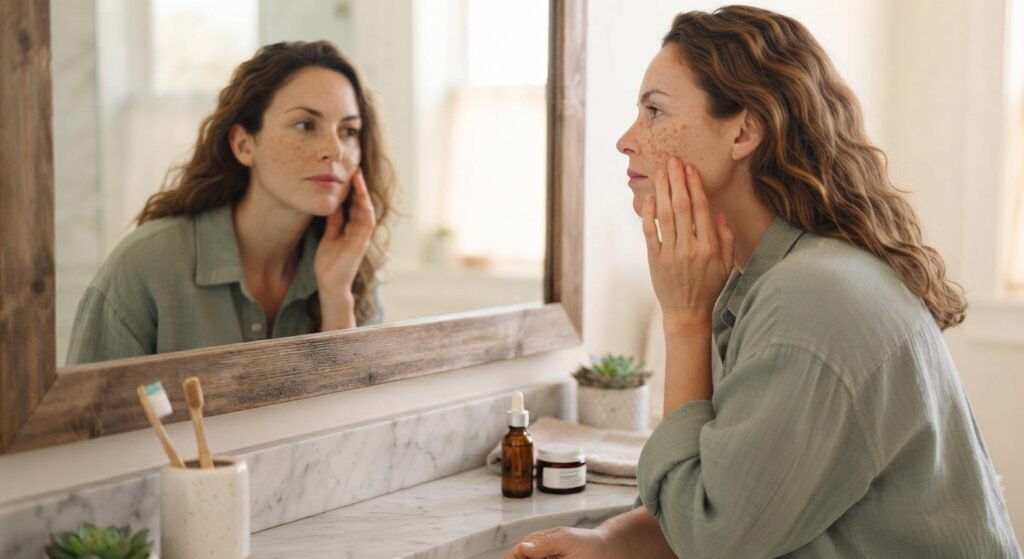

Understanding skin mechanics to treat imbalances from the inside out.
The state of our epidermis too often constitutes the primary visible indicator of our internal imbalances. Whether it involves persistent redness, localized dryness, or exacerbated skin reactivity, the general tendency consists of multiplying the application of superficial topical solutions. Yet, a rigorous dermatological approach demonstrates that skin health is not managed solely on the surface. Before considering any skincare strategy, it is fundamental to decode the physiology of the skin: its intrinsic composition, its nutritional mechanisms, and the true causes of its inflammation.
Physiological foundations: what is the skin actually made of?
Skin integrity relies on a complex biological architecture. Far from being a simple passive envelope, the skin is a living organ in its own right, highly vascularized and metabolically active.
- The structural matrix: The dermis is primarily framed by fibrous proteins, namely collagen and elastin, which guarantee tissue firmness, tone, and elasticity.
- The supply system (the capillary network): To ensure its permanent cellular renewal and maintain its protective barrier, the skin depends entirely on microcirculation. The blood transports oxygen, which is indispensable for cellular respiration, as well as macronutrients, essential fatty acids, vitamins, and trace elements.
- The impact of lifestyle on vascularization: Regular physical activity stimulates microcirculation and tissue oxygenation, favoring a luminous complexion. Conversely, a sedentary lifestyle, sleep deprivation, or chronic stress—via the secretion of cortisol—provoke peripheral vasoconstriction. Skin cells then find themselves deprived of their essential nutritional inputs, which accelerates premature aging.
As an empirical yet highly accurate clinical approach emphasizes: what the organism assimilates on a nutritional level inevitably rebounds at the tissue and cutaneous levels. Blood quality directly determinesthe health of the epidermis.
The impact of lifestyle and toxic overload
As soon as one understands that the skin is nourished by the blood flow, the influence of diet and lifestyle becomes scientifically obvious:
- The saturation of emunctories: An industrial diet, rich in refined sugars, poor-quality saturated fats, as well as the consumption of alcohol or tobacco, excessively solicits filtering organs (the liver and intestines). When these emunctories become saturated, the organism resorts to secondary elimination pathways, at the forefront of which appears the skin. This mechanism translates into inflammatory manifestations, blemishes, or a dull complexion.
- Low-grade systemic inflammation: Oxidative stress and a pro-inflammatory diet durably alter the skin's barrier function, rendering it hyper-reactive to external aggressions.
Dermocosmetics and vigilance against irritating agents
Facing a fragile skin, the commercial reflex often leads toward inadequate mass-market formulations. Numerous conventional cosmetic products integrate high concentrations of synthetic perfumes, irritating preservatives, and aggressive surfactants.
Clinical experience in dermatology and the management of intolerant skin or skin prone to eczema impose absolute rigor in the choice of topical products:
- Cutaneous tolerance: In the same way that certain non-noble metals (such as nickel) trigger contact dermatitis and violent allergic reactions, poor-quality excipients in cosmetics damage the hydrolipidic film.
- The choice of purity: It is scientifically preferable to favor virgin vegetable oils from first cold pressing (such as high-quality argan oil or olive oil) or rigorously formulated neutral excipients, free of potential endocrine disruptors and notorious allergens.
Argan oil: synergy between internal nutrition and topical protection
The argan tree (Argania spinosa) offers an exemplary model of a holistic approach. Used ancestrally in its region of origin, argan oil deploys its benefits in a dual capacity:
- Internal usage (dietary oil): Rich in essential fatty acids (omega-6 and omega-9) and phenolic antioxidants, its integration into the diet contributes to nourishing cellular membranes from the inside, thereby protecting collagen fibers against degradation.
- Topical usage (cosmetic oil): Applied to the epidermis, it reinforces the skin barrier, prevents transepidermal water loss, and protects against climatic aggressions. The mastery of artisanal manufacturing processes guarantees the preservation of its active principles.
The nutritional strategy: supporting skin health through the plate
Since skin structure is built from nutrients brought by blood circulation, dietetics plays a major preventive and curative role:
- Protective micronutrients: The integration of foods rich in beta-carotene and antioxidants—following the example of pumpkin soups and seasonal vegetables—supports the body's antiradical defenses.
- Microbiota optimization: A diet rich in fiber and micronutrients supports intestinal health, thereby reducing the systemic inflammation reflected onto the skin.
When should one be alarmed and consult a physician?
While most benign skin imbalances can be managed through optimized lifestyle hygiene and adapted natural care, it is crucial to know how to identify warning signals that require serious medical care. When must one truly panic and consult a dermatologist or a physician without delay? From the appearance of suspicious spots, sudden modifications in the size, shape, or color of a mole, persistent skin lesions that do not heal, or rebellious inflammatory plaques accompanied by pain or signs of infection. Facing these manifestations, self-treatment no longer has a place: a professional medical diagnosis becomes indispensable.
The rigorous approach to skin health demonstrates that the epidermis is the direct reflection of our internal physiology. By combining a fine understanding of vascular and nutritional mechanisms, avoiding the pitfalls of aggressive cosmetics, and relying on rigorous natural active ingredients, it is possible to sustainably restore skin balance and vitality.
Scientific references and sources:
- Chen, Y., & Lyga, J. (2014). Brain-skin connection: stress, inflammation and skin aging. Inflammation & Allergy-Drug Targets, 13(3), 177-190.
- Arck, P. C., et al. (2006). Neuroimmunology of stress: skin takes center stage. Journal of Investigative Dermatology,, 126(8), 1697-1704.
- Krutmann, J., et al. (2017). The skin aging exposome Journal of Dermatological Science,, 85(3), 152-161.
August 30, 2026
Sarah Martinez
Related articles